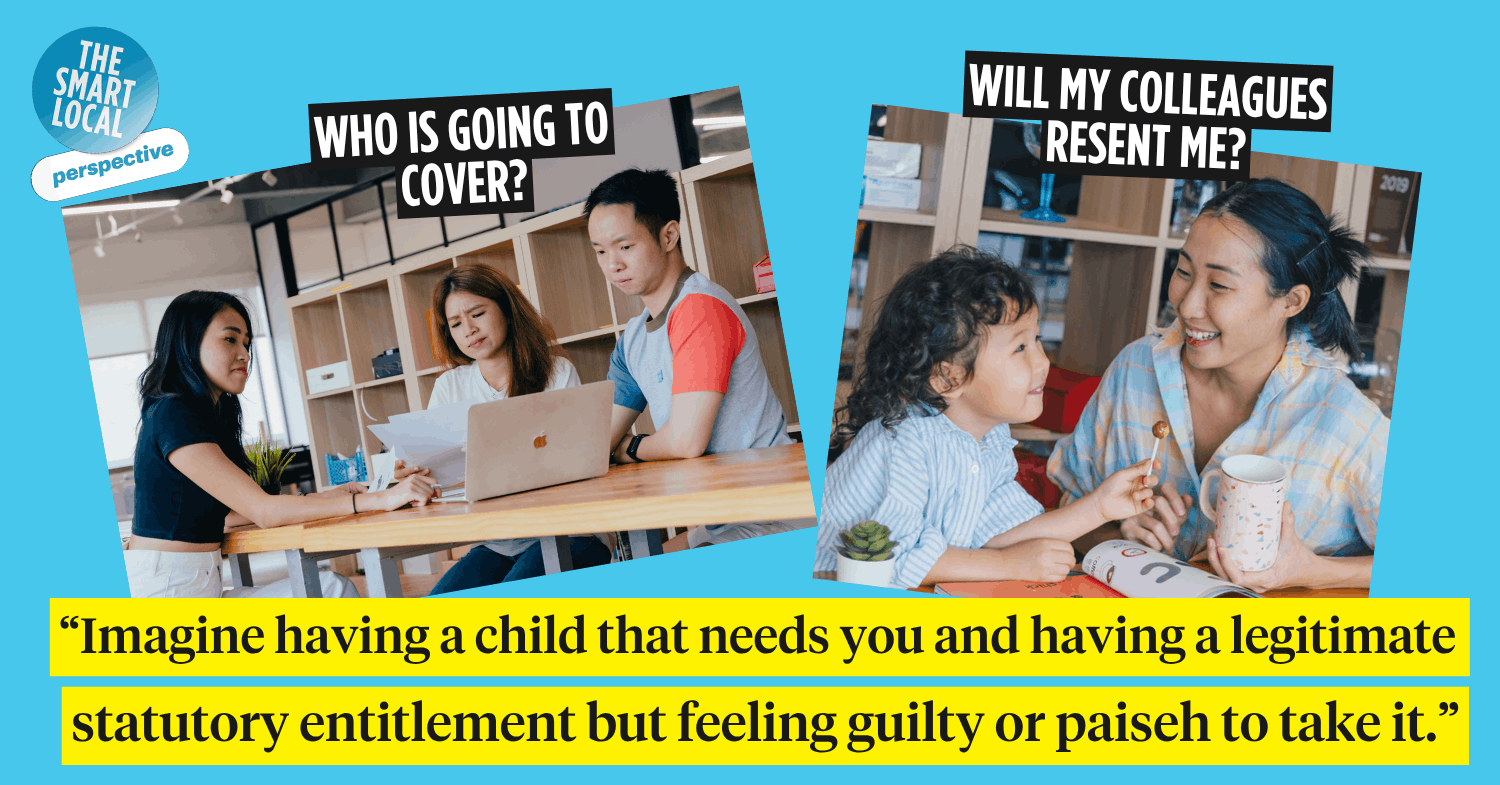

NDR 2026: Childcare leave & workplace culture
During the National Day Rally (NDR) 2026, PM Wong announced a number of new policies for working parents, including extended childcare leave. And while parents cheered, a fair number of others quietly did the math on what this meant for their own workload. On first thought, an understandable reaction. On second thought, why is that the narrative that has quickly taken over most of the discussion around childcare leave?
Somehow we’ve normalised this equation: Parent takes childcare leave -> colleague covers -> colleague gets resentful -> parents feel guilty. Pretty sad state of affairs for everyone involved, isn’t it?
Full disclosure: this author is not a parent, has no kids, and has covered for parent colleagues on several occasions. The initial question we started with was: “Why does it seem like we have little empathy for parents, who are our own colleagues?”
The bigger picture might have more to do with work culture
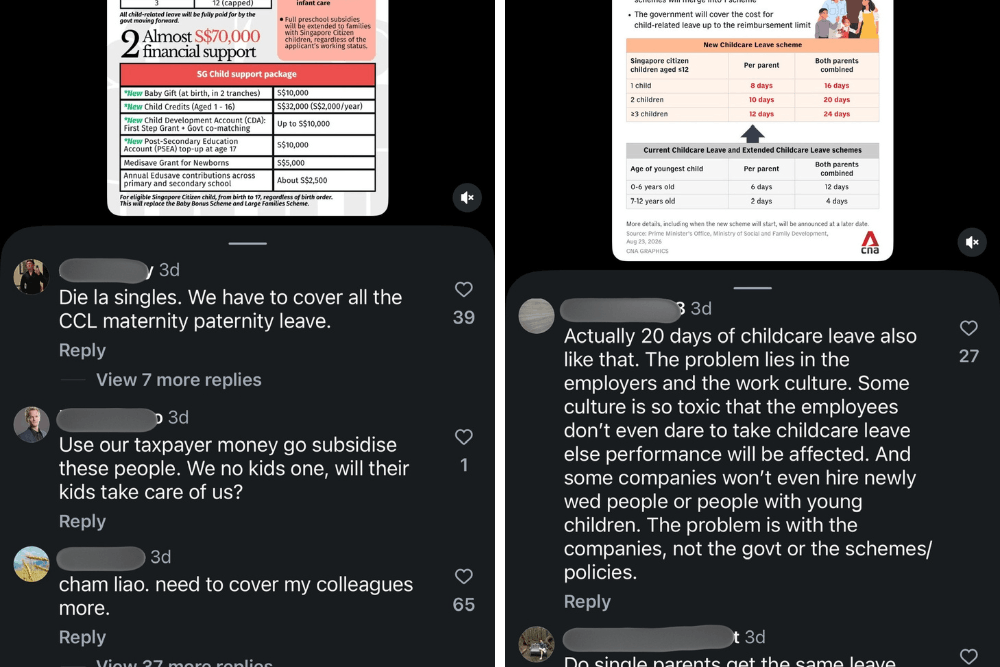
The backlash raises a bigger question as to why colleagues are being pitted against each other in the first place.
Screenshot from: Instagram
And then, looking at the bigger picture, the real question is what all the discourse says about Singapore’s work culture. The frustration of absorbing additional work of absent colleagues is very real. But who are we really annoyed at – our teammate, our company, or the policymakers? From a large portion of the online reactions, it seems to collapse all 3 into 1 target: the parent taking leave.
Let’s pause and really think about that. After all, the policy was announced with wholesome intentions to give parents more time with their kids. Yet, most comments seem to suggest that this is basically a direct penalty for child-free workers.
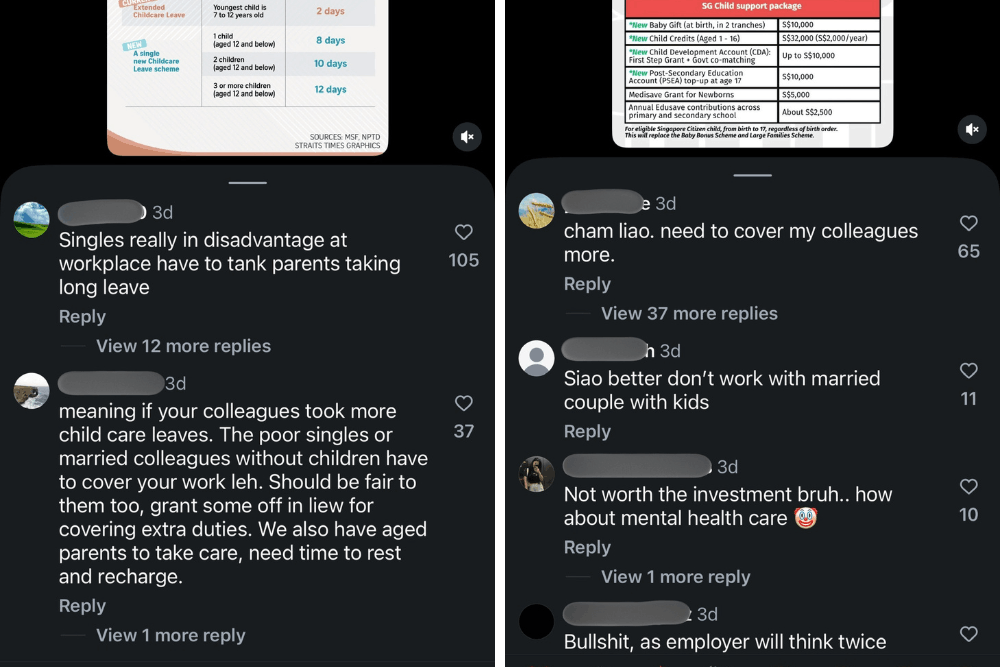
Screenshot from: Instagram
While the concern that non-parents have about extra workload is genuine, what’s worrying is that we’ve become so accustomed to seeing parents’ needs and colleagues’ needs as competing interests that the first response to a policy giving parents more support is, “Who is going to cover for them?”
Businesses have their own set of problems to deal with
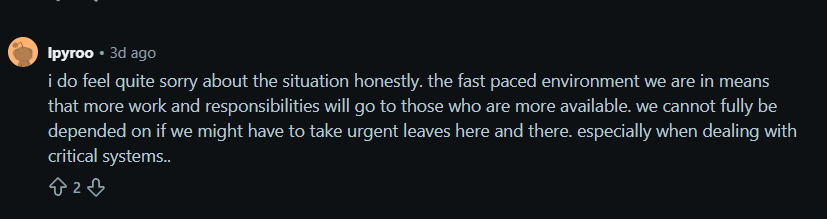
Screenshot from: Reddit
Here’s the thing. Pointing fingers at workplaces isn’t always the answer either. Businesses have raised manpower concerns, with sectors such as manufacturing and events facing genuine difficulties because certain roles require people to be physically present or have specialised skills.
Tan Boon May, a mother of 3 and the owner of 2 math tuition centres, raised some genuine structural issues. Even with the Government reimbursing salaries, employers still have to physically find someone to cover the work, and that’s genuinely difficult when the role needs a specific skill set. As she said, you can’t sub in a random hire to teach a math class.
She also pointed out that salary reimbursement isn’t the same as the full cost of employing someone. Rent, training, admin, and management overhead don’t disappear just because the Government is covering the paycheck. Sometimes finding cover costs more than the missing salary.

Screenshot from: Instagram
Her biggest worry, though, was that the well-intentioned policy could unintentionally make employers warier of hiring people with caregiving responsibilities in the first place. Strike 2 for parents.
It’s an operations and hiring-bias problem, and it’s one that requires workplaces to be redesigned around that reality. HR practices, flexible arrangements, and contingency planning are all part of the plan. NTUC and Labour MPs, while welcoming the leave increase, also explicitly urged employers to let staff use it without fear that it’ll cost them a promotion, which tells you the worry isn’t hypothetical; it’s already being flagged at the national level.
Do we really need to fault someone for this real-life situation?
None of this should turn into a reason to make parents feel guilty for taking leave they’re entitled to. But it does mean the anxiety about who is covering for whom deserves a better answer than shrugging at the parent next to you.
Not every company has the runway to make structural changes overnight. So, almost everyone involved has a grievance around the new policy. The Government can reimburse a salary. It can’t fully reimburse the actual cost of covering someone, and it can’t reimburse the stress of a last-minute handover, or the paiseh-ness a parent feels asking for help.

Image for illustrative purposes only.
The more useful workplace questions, then, might be:
- Is there adequate manpower to begin with?
- Are responsibilities documented and shared, or does one person quietly hold all the institutional knowledge?
- Can someone else realistically perform this role, even partially?
- Is emergency coverage rotated, or does the same person always get dumped with the extra work?
- Does management actually recognise and account for the additional load?
The silver lining, if companies step up
It’s worth acknowledging that the size of a business matters a lot. A large organisation usually has more slack to absorb an absence. A team of 8 with no redundancy does not, and that’s true no matter how good the Government’s intentions are.

Image for illustrative purposes only.
Even with that caveat, let’s try to find a silver lining for a second. The Government’s childcare leave expansion could force companies to get better at dealing with absence. That could mean:
- Better documentation
- More cross-training
- Clearer handovers
- Better workload planning
- Less dependence on individual employees
- More flexible staffing
- Greater acceptance of caregiving generally
But even with all that planning, some roles will never be easily replaceable. Someone will still have to pick up the slack sometimes. That’s the uncomfortable truth no policy fully solves.
What could actually help all parties involved
If that’s the case, could we reframe how we talk about the situation to show more compassion for our colleagues who are parents? We don’t have to pretend the friction disappears, but we can make it easier for the parent to take leave without mentally calculating whether it’s worth the resentment it might invite.

Image for illustrative purposes only.
Most of the time, they don’t have complete control over whether their child suddenly gets sick or injured, whether school closes, or whether childcare falls through. And children are dependents. It would be devastating to simply be told, “Sorry, Mummy/Daddy has a deadline.”
Imagine having a child that needs you and having a legitimate statutory entitlement but feeling like, “I better not take it because my colleagues will hate me.” That’s not the kind of workplace culture anyone is going to thrive in.
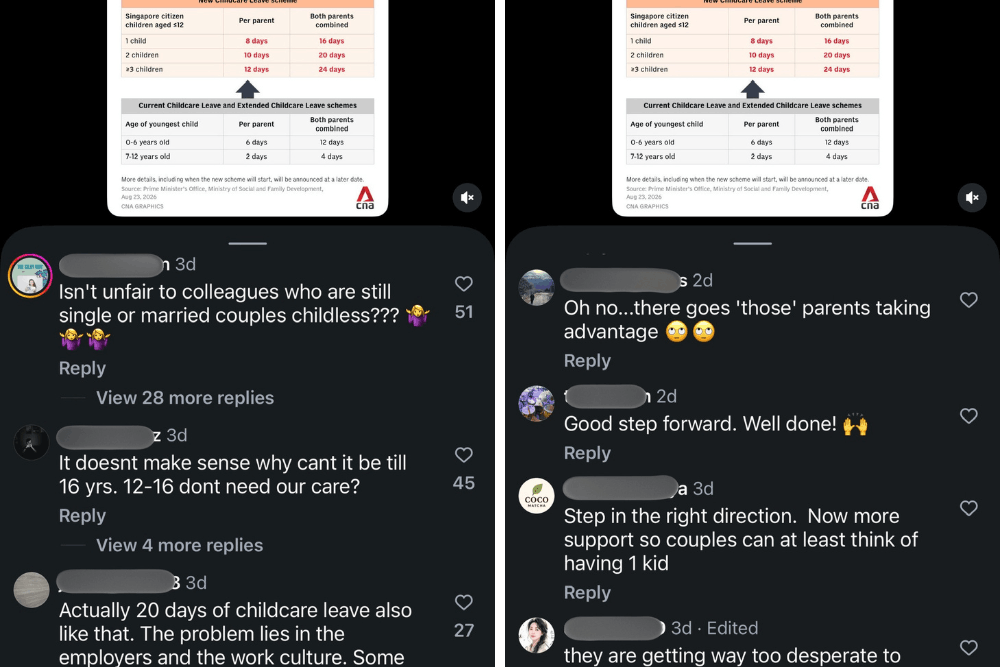
Screenshot from: Instagram
If every time a parent takes childcare leave, the office sighs, rolls its eyes, or makes jokes about who’s covering their work, the entitlement exists on paper but not necessarily in culture.
A few concrete things that could help everyone in this situation:
- Speaking up at the workplace isn’t always easy, but if you’re the one absorbing extra work, point it out to your manager directly, rather than letting it curdle into resentment toward the colleague who’s on leave. The workload gap is a staffing problem you can flag upward instead of holding a grudge sideways.
- If you’re the parent, a comprehensive handover note goes a long way toward making the leave feel like a plan rather than a scramble.
- If you’re the employer, treat “who covers this” as a question to answer way before someone needs leave, not while they’re already gone.
There’s room for everyone’s frustrations in a more empathetic workplace culture
Yes, let’s keep our bosses and managers accountable for making sure the arrangements are as smooth as reasonably possible. Yes, let’s acknowledge that other team members are doing real, extra work. And let’s not be part of a workplace culture that makes parents feel guilty about using their entitlement either.
The colleague who has to stay until 9pm to cover is going the extra mile and isn’t being petty. The parent whose kid has needs isn’t being deliberately inconsiderate. Both can be true at the same time, and maybe what we all need is mutual understanding and empathy for everyone stuck in the same system.
Cover image adapted from: The Smart Local