

PSLE dates, scoring system & SBB
If you’re a parent reading this, congratulations on hitting a milestone in your child-raising journey: the PSLE year. Just when you thought you could lend some sagely wisdom to your offspring from your own PSLE experience back in the day, MOE has gone ahead to change up the whole system as we know it. AL? SBB? What does it all mean?
We break down the differences for you, and shed light on why these changes had to be made. It may be a bit troublesome to grasp at first, but it was implemented with lots of benefits in mind, from less stressed kids to more fulfilled potential. No complaints there!
PSLE dates in 2026

Image credit: Writers At Work
First, let’s lay out the PSLE dates in 2026 so you can mark them down on your calendar. It’s good to map out your child’s revision – and tuition, if you deem necessary – gameplan early on so both of you aren’t left scrambling in the later months of the year. Q3 will come faster than you think!
| Date | Paper | Time |
| 12th Aug (Wed) | Oral Examination | 8am to 1.30pm |
| 13th Aug (Thu) | ||
| 15th Sep (Tue) | Mother Tongue Listening Comprehension | 9am to 9.35am |
| English Listening Comprehension | 11.15am to 11.50am | |
| 24th Sep (Thu) | English Language Paper 1 (1h 10 min) | 8.15am to 9.25am |
| English Language Paper 2 (1h 50 min) | 10.30am to 12.20pm | |
| 25th Sep (Fri) | Mathematics Paper 1 (1h 10 min) | 8.15am to 9.25am |
| Mathematics Paper 2 (1h 20 min) | 10.30am to 11.50am | |
| 28th Sep (Mon) | Mother Tongue Paper 1 (50 min) | 8.15am to 9.05am |
| Mother Tongue Paper 2 (1h 40 min) | 10.15am to 11.55am | |
| 29th Sep (Tue) | Science Paper 1 (1h 45 min) | 8.15am to 10am |
| 30th Sep (Wed) | Higher Mother Tongue Paper 1 (50 min) | 8.15am to 9.05am |
| Higher Mother Tongue Paper 2 (1h 20 min) | 10.15am to 11.35am |
Refer to the full PSLE timetable for foundational subject examination dates and timings.
Why was the PSLE scoring system changed?
You and I probably remember PSLE scores as that 3-digit figure, where mid- to high-200 aggregates would induce a dramatic gasp. This was known as the T-score (Transformed Score) system, which measured students’ performance relative to the rest of the cohort. In other words, your score depended partly on how well everyone else did, not just your own marks.

Image credit: Study Smart
Each examinable subject – that is, English, Maths, Science, and Mother Tongue – was converted into a T-score using a statistical formula, and the 4 subject scores were added up to form the final PSLE aggregate. Because scores were calculated relative to cohort performance, factors like a particularly difficult paper or many students scoring similarly could affect how T-scores were distributed.
In a system designed to rank students so precisely, even small differences in marks could lead to noticeable shifts in T-scores and rankings. This meant minor gaps in exam marks could influence not just the final score on a student’s result slip, but also the range of secondary schools they were eligible to enrol into. If a large number of students get funneled into a certain T-score bracket, competition for applicable secondary school openings becomes intense.
What is the new PSLE scoring system?
Image credit: BlueTree Education
As of 2021, the new PSLE scoring system became as such:
- For each examinable subject, you would get an Achievement Level tagged to your exam marks, ranging from AL1 to AL8.
- Each Achievement Level is tied to a range of marks, called mark bands:
- AL1: 90-100
- AL2: 85-89
- AL3: 80-84
- AL4: 75-79
- AL5: 65-74
- AL6: 45-64
- AL7: 20-44
- AL8: Below 20
- Your final PSLE score will be the sum of your AL scores for all 4 subjects, with 4 being the best and 32 being the lowest. So, you wanna aim for the lowest possible score.
Comparing the previous PSLE scoring system and how things work now, the T-score system graded students on a curve. But with the banded grades in the new AL system, if you score within a certain mark range, you will get that specific grade and final score regardless of how others perform.
What is Full Subject-Based Banding aka Full SBB?
We went down memory lane talking about the old PSLE scoring system, now let’s talk about streaming. And no, not the video streaming kind. It was essentially the way our generation got sorted into Express, Normal Academic, and Normal Technical streams when advancing to secondary school.
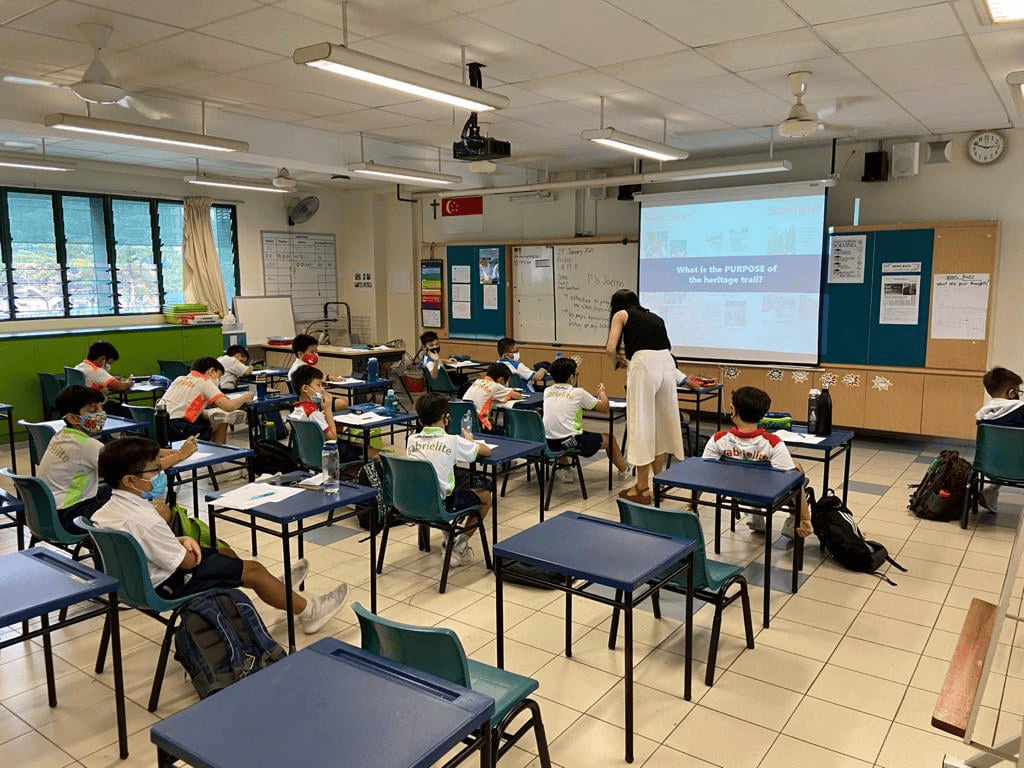
Image credit: St. Gabriel’s Primary School
As of 2024, all secondary schools in Singapore shifted to a programme called Full Subject Based-Banding (Full SBB) or just SBB for short. Students now get to take subjects at different levels, in mixed-form classes. The subjects are classified into:
- G3: The highest level, similar to former Express
- G2: Middle level, similar to former Normal Acad
- G1: Foundational level, similar to former Normal Tech
To illustrate with an example, a student who is gifted in language and humanities might take English and History at G3, Science at G2, and Maths at G1 ‘cause they catch no ball with algebraic formulae and Pythagoras’ theorem.

Image credit: Wikimedia Commons
The benefit is clear: students get to mix subject levels based on their strengths, rather than being locked into one rigid stream for all subjects.
In the case of our example, taking Maths and Science at a level that is too advanced for their capabilities means added stress and less support to help them grasp the foundations of their weaker subjects. But if we were to chuck this student into a Normal Acad or Normal Tech stream like back in the old system, they miss out on the opportunity to hone their language and humanities prowess.
How secondary school posting works with the new PSLE scoring system

Image credit: Lee Hsien Loong via Facebook
Now that you’re familiar with the changes in the PSLE scoring system as well as SBB rather than traditional streaming, let’s talk about how secondary school posting works. PSLE scores place students into Posting Groups for Sec 1 admission. These groups roughly correspond to the subject levels they start with. For instance:
- Posting Group 3: Mostly G3 subjects
- Posting Group 2: Mostly G2 subjects
- Posting Group 1: Mostly G1 subjects
There’s flexibility in this new system in that students can take certain subjects at a higher level if they perform well in that subject.
As compared to traditional streaming, where you are pretty much stuck in your stream for the whole course of your sec school studies save for the extremely exceptional cases, SBB offers a lot more room for shifting and adapting based on every student’s developing proficiency levels.
Benefits of the new PSLE scoring system & SBB
Now you know how it all works. Before you fuss about having to learn the ins and outs of a whole new system, this certainly isn’t a case of “if it ain’t broke, don’t fix it”.
The old T-score system used calculations which produced over 200 possible aggregate scores, thus differentiating students super precisely. Meanwhile, the new system uses Achievement Levels, which can produce only 29 possible variations. With more students sharing the same scores, more schools will have similar cut-off points, which gives students a wider range of choices to enrol in.

Image credit: Shutterstock
Precision aside, the new system also scores students based on their individual performance rather than their results relative to their peers in the same academic year. And with the broader scoring bands, the pressure is reduced on students having to compete among themselves for the tiniest of score differences.
As with SBB, students can now be banded according to both their strengths so they can flourish further, as well as the subjects in which they require more care and support so they aren’t left behind to flounder on their own. It’s very much about flexibility and recognising every students’ unique learning needs. Not gonna lie, it kind of makes me wish we had SBB back in our generation!
Find out more about the new PSLE scoring system
Cover image adapted from: Writers At Work, Lee Hsien Loong via Facebook